
SSDI and VA Disability Benefits
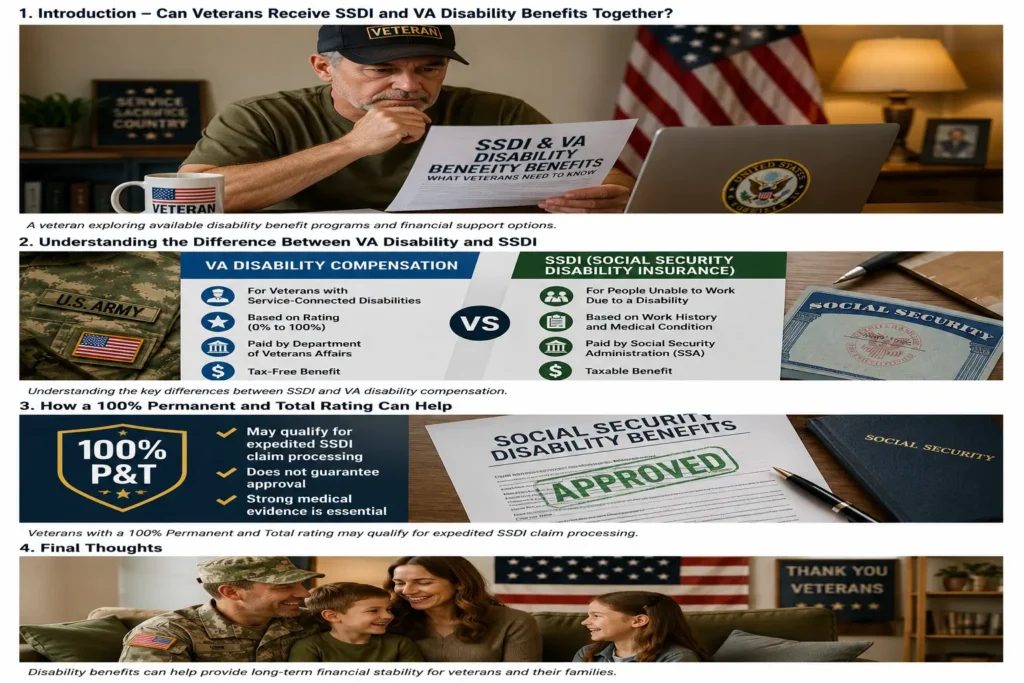
Many veterans wonder whether they can receive Social Security Disability Insurance (SSDI) while also collecting VA disability compensation. The good news is that, in many cases, the answer is yes. However, these are two separate programs with different eligibility requirements, application processes, and rules.
In this guide, we’ll explain how SSDI and VA disability benefits work together, what veterans should know before applying, and how a 100% VA disability rating may affect an SSDI claim.
Can You Receive SSDI and VA Disability Benefits Together?
Yes. Veterans can receive both SSDI and VA disability compensation at the same time if they qualify for both programs.
The U.S. Department of Veterans Affairs (VA) and the Social Security Administration (SSA) operate independently. Receiving benefits from one program does not automatically qualify you for benefits from the other.
Most importantly, receiving SSDI will not reduce your VA disability compensation, and receiving VA disability compensation will not reduce your SSDI payments.
Understanding the Difference Between VA Disability and SSDI
Although both programs provide disability benefits, they serve different purposes.
VA Disability Compensation
VA disability compensation is available to veterans who have a service-connected disability resulting from military service.
Key points:
- Disability must be linked to military service.
- Veterans can receive ratings from 0% to 100%.
- Partial disability ratings are allowed.
- Employment status generally does not determine eligibility.
SSDI (Social Security Disability Insurance)
SSDI is administered by the Social Security Administration.
Key points:
- Disability does not need to be service-connected.
- The condition must prevent substantial gainful employment.
- The disability must be expected to last at least 12 months or result in death.
- Applicants must have sufficient work credits.
Unlike VA disability compensation, SSDI is generally an all-or-nothing benefit. Applicants are either approved or denied based on SSA’s disability standards.
Does a 100% VA Disability Rating Automatically Qualify You for SSDI?
No.
Many veterans mistakenly believe that a 100% VA disability rating automatically guarantees SSDI approval. Unfortunately, that is not how the system works.
The Social Security Administration uses its own disability standards and medical review process. Even veterans with a 100% Permanent and Total (P&T) VA rating must prove that their medical conditions prevent them from maintaining substantial employment.
Medical evidence, treatment records, physician opinions, and work limitations remain critical parts of any SSDI application.
How a 100% Permanent and Total Rating Can Help
Although a 100% P&T rating does not guarantee approval, it can provide an important advantage.
Veterans with a 100% Permanent and Total disability rating may qualify for expedited SSDI claim processing.
This means the Social Security Administration may review the claim faster than a standard application.
However, expedited processing does not mean automatic approval. The applicant must still meet all SSDI eligibility requirements.
What About TDIU Veterans?
Veterans receiving Total Disability based on Individual Unemployability (TDIU) may have stronger evidence when applying for SSDI.
TDIU is granted when service-connected disabilities prevent a veteran from maintaining substantially gainful employment.
Since SSDI also focuses heavily on the ability to work, TDIU documentation may help support an SSDI claim. However, SSA will still conduct its own independent review.
SSDI Eligibility Requirements for Veterans
To qualify for SSDI, applicants generally must:
- Have a severe medical condition.
- Be unable to perform substantial work.
- Have a disability expected to last at least one year or result in death.
- Possess sufficient Social Security work credits.
Military service often provides veterans with enough work history to satisfy SSDI credit requirements, but each case is unique.
Can Veterans Also Qualify for SSI?
In some situations, yes.
Supplemental Security Income (SSI) is a separate program for individuals with limited income and resources.
Unlike SSDI, SSI is based on financial need rather than work history.
Veterans with low income and limited assets may qualify for SSI in addition to other benefits.
Key Takeaways
- Veterans can receive SSDI and VA disability benefits simultaneously.
- VA disability compensation does not reduce SSDI benefits.
- SSDI benefits do not reduce VA compensation.
- A 100% VA rating does not automatically guarantee SSDI approval.
- Veterans with a 100% Permanent and Total rating may receive faster SSDI claim processing.
- Strong medical evidence remains essential for SSDI approval.
Final Thoughts
Understanding the differences between SSDI and VA disability compensation can help veterans make informed financial decisions. While the two programs operate under separate rules, many veterans successfully receive benefits from both.
If you believe your medical condition prevents you from working and is expected to last at least 12 months, exploring SSDI may be worthwhile. Be sure to gather strong medical evidence, employment records, and supporting documentation before applying.
Disclaimer
This article is for informational purposes only and should not be considered legal, financial, or benefits advice. Eligibility requirements and benefit rules may change. Always consult official government resources or a qualified benefits professional for guidance.